
|
Getting your Trinity Audio player ready...
|
Dar es Salaam, Tanzania: What began as a day of hope has descended into one of the darkest moments in Tanzania’s recent political history. Streets once filled with the hum of democracy are now clouded with tear gas and uncertainty.
Across Dar es Salaam, Arusha, and Mwanza, the echoes of chants for freedom compete with the sharp crack of rubber bullets.
For weeks, Tanzanians had been preparing to cast their votes in what many believed could mark a new era for the country’s multi-party democracy. President Samia Suluhu Hassan, seeking a second term, faced a rejuvenated opposition coalition that had gained unprecedented traction among young voters and urban professionals.
But before polls even opened, the air was heavy with tension. Reports began filtering through social media that several opposition presidential candidates had been detained overnight. Among them were some of the coalition’s most recognizable figures, men and women who had drawn massive crowds in their final campaign rallies, and who had dared to challenge what critics increasingly call Tanzania’s creeping authoritarianism.
“These arrests are a betrayal of our democracy,” said one opposition supporter outside a shuttered polling station in the Temeke district of Dar es Salaam. “They are afraid of losing, so they lock up those who could win.”
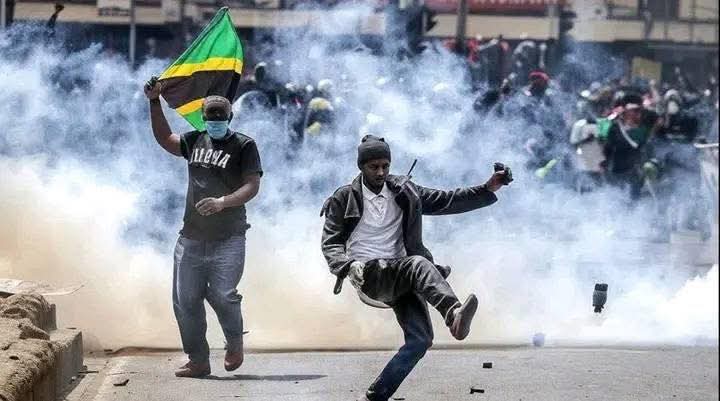
By midmorning, peaceful demonstrations had begun to form in several cities. Protesters waved flags, held aloft posters demanding “Free Our Leaders,” and chanted slogans calling for fair elections. Within hours, the situation spiraled.
Police moved in with riot gear and tear gas, breaking up gatherings and arresting dozens. Witnesses reported the use of rubber bullets and water cannons. Videos circulating online were quickly taken down, showing police chasing protesters through the streets, firing into crowds.
As the violence intensified, the government restricted social media platforms and slowed internet access, triggering what watchdog group NetBlocks later described as a “nationwide digital blackout.” “This is no longer a democratic process, it’s a crackdown,” shouted one young protester before being whisked away by police. His fate remains unknown.
By nightfall, Dar es Salaam was under curfew. Police patrols roamed the city of more than seven million people, ordering residents indoors. The normally bustling markets around Kariakoo were deserted; shopkeepers locked their stalls early, fearful of looting or arrests.
Major roads, including the highway leading to Julius Nyerere International Airport, were blocked. The U.S. Embassy issued a statement warning its citizens to avoid public gatherings and confirmed that “multiple main arteries in and out of the city” had been closed.
“We are deeply concerned by the reports of violence and the detention of political figures,” the embassy said, calling for “calm, transparency, and respect for democratic processes.” Inside Tanzania, silence reigns. State-run television and radio have made no mention of the unrest.
The few independent journalists who dared to report from the streets say they have faced intimidation and threats of arrest.
“The official narrative is that everything is calm,” said one journalist who spoke on condition of anonymity. “But the truth is that people are terrified. No one knows what’s happening, and the internet blackout makes it worse.”
A diplomatic source told journalists that as many as 30 people may have been killed in Wednesday’s violence, a figure impossible to verify amid the communication blackout. Hospitals in Dar es Salaam and Arusha have reportedly received dozens of injured protesters, some with gunshot wounds.
Despite the blackout, some Tanzanians have found ways to coordinate through encrypted platforms like Zello and Signal, discussing plans for renewed demonstrations. “We cannot be silent,” one voice message shared on Zello declared. “They can take our leaders, but they cannot take our courage.”
Yet, the mood in the country is grim. Many fear an extended period of unrest or even a slide into deeper authoritarian control.
President Samia Suluhu Hassan came to power promising stability and reform. Her tenure initially drew praise from international observers for restoring diplomatic ties and easing restrictions on opposition parties that had been suffocated during the previous administration. But the events of this election have raised serious questions about her government’s commitment to those ideals.
“This election could have been a turning point for Tanzania’s democracy,” said Dr. Michael Kweka, a political analyst at the University of Dar es Salaam. “Instead, it may be remembered as the moment it broke.”
As the curfew stretches into its second night, the people of Tanzania wait not only for results that may already be decided behind closed doors, but for signs that their voices still matter.
The city is quiet now, save for the distant hum of police vehicles and the crackle of burning debris. But beneath the silence, an uneasy truth lingers: democracy in Tanzania is hanging by a thread.