
|
Getting your Trinity Audio player ready...
|
The political ground beneath former Deputy President Rigathi Gachagua appears to be rapidly shifting, as a growing number of lawmakers and regional power brokers once loyal to him abandon his camp and gravitate toward President William Ruto.
The unfolding defections have exposed deep cracks within Gachagua’s political base, raising questions about his influence in the Mt Kenya region as the country edges closer to the 2027 General Election.
At the center of the latest political intrigue is the unexpected public appearance of Muhoho Kenyatta, brother to former President Uhuru Kenyatta, at State House in the company of President Ruto.
The encounter has been widely interpreted as a symbolic thaw between the Kenyatta family and Ruto two political forces that have been at odds since the dramatic fallout between Uhuru and his deputy in 2018.
That rupture reshaped Kenya’s political landscape, ultimately pushing Uhuru to support Raila Odinga in the fiercely contested 2022 presidential race.
For years, the Kenyatta family has been among President Ruto’s most vocal critics, making Muhoho’s State House appearance a significant moment that has sent ripples through Mt Kenya politics.
Analysts argue that the gesture signals a broader recalibration of political interests within the region, where pragmatism appears to be overtaking past rivalries.
Against this backdrop, Gachagua’s Democracy for Citizens Party (DCP) is facing its most serious test yet.
Several high profile allies have either defected or openly distanced themselves from the party, dealing a major blow to the former deputy president’s efforts to position himself as a regional kingpin.
The defection of Juja MP George Koimburi proved particularly damaging. Once a close ally, Koimburi publicly accused the DCP leadership of internal sabotage, poor coordination, and what he described as “commandership politics.”
He claimed that internal wrangles within the party created space for local political competitors to weaken him in his own constituency, leaving him with little choice but to chart a new political path aligned with President Ruto.
Koimburi’s exit was soon followed by the quiet but telling departure of other prominent figures. Among those who have since abandoned Gachagua’s camp are Githunguri MP Gathoni Wamuchomba, Maragua MP Mary Wamaua, Kangema MP Peter Irungu, former Nyeri Town MP and influential strategist Ngunjiri Wambugu, and former Bahati MP Kimani Ngunjiri.
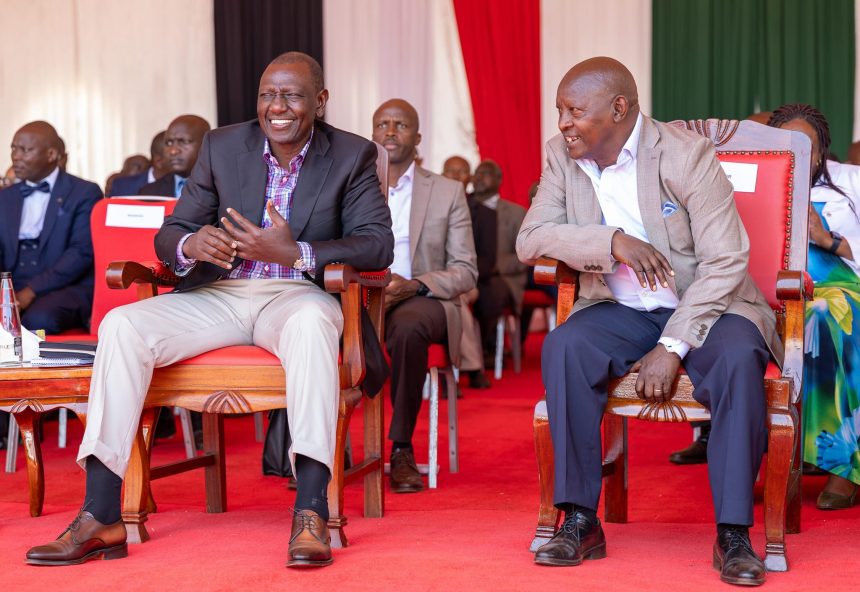
Collectively, these leaders represent a substantial political footprint in Mt Kenya, and their defection has significantly weakened Gachagua’s regional network.
In response, Gachagua has adopted a combative tone, accusing the defectors of betraying the very community that elevated them to leadership.
In a thinly veiled warning to President Ruto, he cautioned that Mt Kenya voters are unforgiving when it comes to perceived disloyalty.
“The Mt Kenya region hates betrayal.
Our people do not forget easily. Those who betray the region will pay a heavy political price. President Ruto should be very cautious,” Gachagua said.
President Ruto, however, appears unfazed by the criticism.
He has continued to project an image of stability and delivery, focusing heavily on youth empowerment and economic inclusion key pillars of his administration.
While launching the second phase of the Nyota Project, under which 50,000 young people received seed capital for small businesses, the president issued a sharp rebuke to the opposition.
He warned young Kenyans against being lured by what he described as hollow political promises, arguing that some leaders are only interested in votes without offering tangible solutions to unemployment and economic hardship.
“Those in the opposition only talk about votes. They do not explain their plan for the youth. If someone wants your vote, they must clearly tell you how they will help you,” Ruto said.
Political observers note that these developments underscore a broader trend of strategic realignments as the 2027 General Election approaches.
Leaders are increasingly prioritizing proximity to power, access to resources, and political survival over ideological loyalty. Parties are being tested, alliances renegotiated, and former rivals are finding common ground in pursuit of relevance.
For Gachagua, the defections pose an existential challenge to his political future and his claim to Mt Kenya leadership. For President Ruto, the steady stream of defectors strengthens his hand and reinforces his narrative of a broad, inclusive coalition.
As the countdown to 2027 continues, Kenya’s political landscape is set for even more dramatic shifts, with loyalty, ambition, and survival shaping the next chapter.